True DIY Mini Split Quick Connect Systems: Which Ones Skip the Vacuum Pump
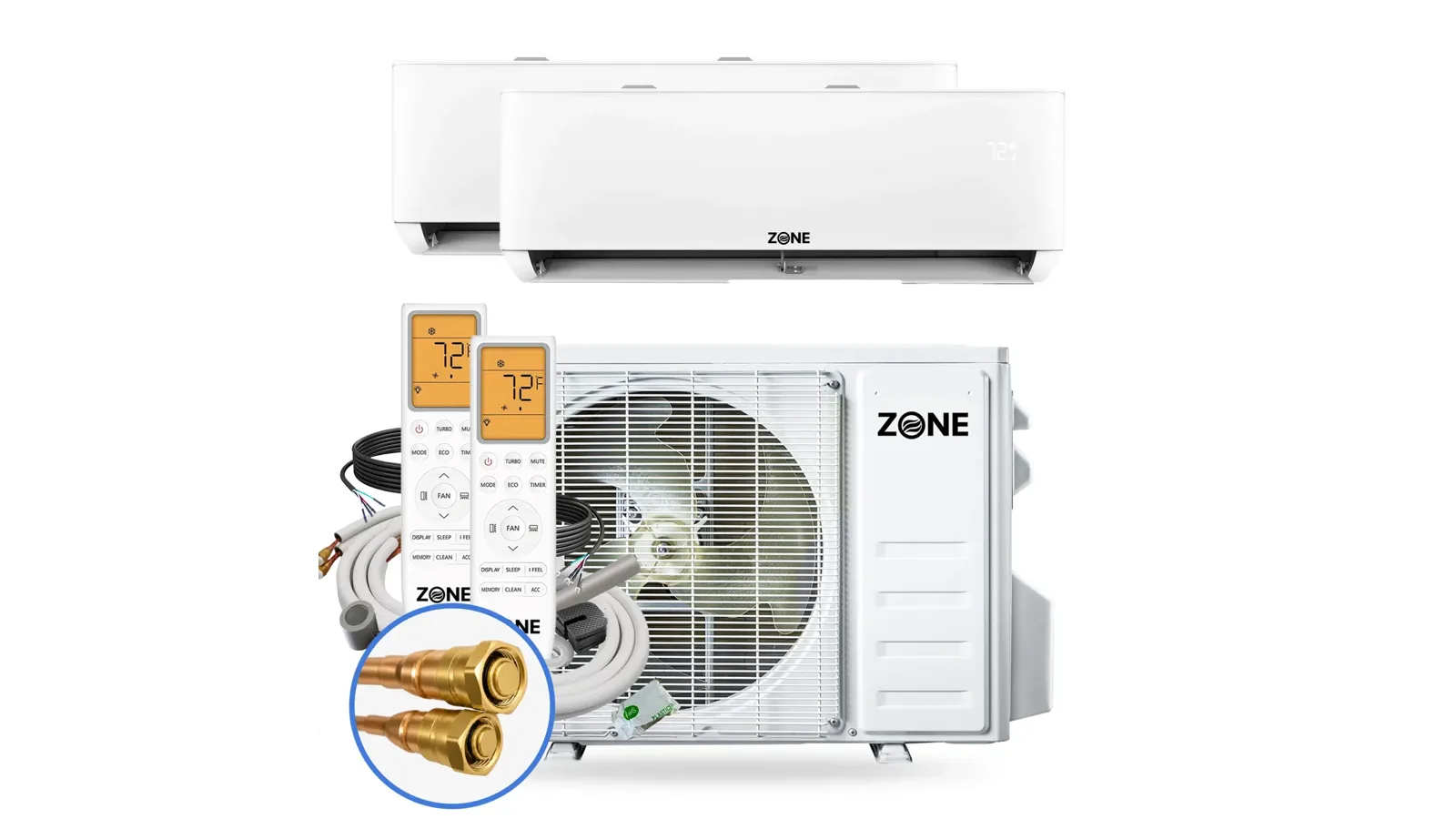
True diy mini split quick connect systems are the ones that ship with a pre-charged line set and sealed quick connect fittings, so you can install it without a vacuum pump, a gauge set or any refrigerant work. Plenty of systems carry a "DIY" label, but far fewer actually pass that test, and the difference is all in how the refrigerant lines connect.
This guide sorts the field into the systems that really are pre-charged quick connect installs and the flare-based ones that still need the vacuum step, then covers what the EPA rules mean for a homeowner, which setup is easiest to install, and how 115V and 230V models differ.
What Makes a Mini Split True DIY
One piece of hardware can make the call: the pre-charged quick connect line set. On a true DIY system the outdoor unit and the line set both have left the factory filled with refrigerant and sealed at each end. Each fitting has a spring-loaded valve that stays shut until the part is screwed on and torqued, and only then does refrigerant flow. The circuit is never open to air, so there is nothing to evacuate.
That one design choice removes the three steps that usually push a ductless install to a technician: no vacuum pump pulling the lines down to about 500 microns, no manifold gauges and no adding refrigerant from a tank by weight. What's left is mechanical work you can do with ordinary tools. You'll mount the wall bracket, cut a wall pass-through of about 3 inches, hang the indoor unit, route the lines, connect the fittings and make the electrical connections.
Watch for one phrase on product listings. "Pre-charged condenser" and "pre-charged line set" are not the same claim. Most flare systems ship with refrigerant in the outdoor unit, but the copper lines and indoor coil arrive empty and full of air, so they still have to be pumped out before the valves are opened. Only a pre-charged line set with sealed fittings is a no-vacuum install. If the box holds bare copper and flare nuts, it isn't true DIY, whatever the label says.
What EPA Rules Mean for Homeowners
Under EPA Section 608, certification is about opening refrigerant circuits during service, repair and disposal and buying refrigerant. Connecting a factory-sealed quick connect line set by the manufacturer's instructions doesn't open the circuit or put refrigerant in your hands, and that is why a pre-charged system has no 608 step in the install.
Two rules still apply to everyone. Knowingly venting refrigerant is illegal whether or not you are certified, so a sealed line is never cut or made shorter. And since 2018 the refrigerant sales limit has covered HFC refrigerants such as R-410A and R-454B, so buying refrigerant in containers over 2 lb takes a 608 certification. In practice a homeowner can legally install a pre-charged system but can't buy refrigerant to top one up. That is why a leak repair is a job for a certified technician. Electrical work is separate again and may need a permit or a licensed electrician under local code.
The True DIY Quick Connect Shortlist
These systems ship with pre-charged quick connect line sets and can be installed with no vacuum pump:
- Zone Air. Every Zone Air system uses pre-charged quick connect line sets, cut to any whole foot from 5 to 75 ft. Single-zone wall systems come with a 16 ft set in the box. The 12K 230V wall system is rated 24 SEER2, the 12K 115V is 23 SEER2, and every system heats down to −13°F.
- MRCOOL DIY. MRCOOL also sells pre-charged quick connect line sets, in fixed 11.5, 16, 25, 35 and 50 ft lengths with connectors for longer runs, so MRCOOL isn't the only true DIY brand.
- Airspool HS12. The HS12 comes with a pre-charged twist-to-connect line set (10 ft, customizable to 49 ft), goes into a 120V NEMA 5-20 outlet, is rated 21.5 SEER2 and heats down to −22°F, with optional solar input.
- EG4 12K Hybrid Solar. EG4's 12K hybrid uses a 16.4 ft pre-vacuumed quick connect line set, is rated 22.5 SEER2 and takes up to 1,100 W of DC solar input, but it heats only down to 5°F.
| System | Line connection | Vacuum pump | SEER2 (12K class) | Heats down to |
|---|---|---|---|---|
| Zone Air 12K | Pre-charged quick connect, 5–75 ft | Not needed | 24 (230V) / 23 (115V) | −13°F |
| Airspool HS12 | Pre-charged twist-to-connect, 10–49 ft | Not needed | 21.5 | −22°F |
| EG4 12K Hybrid | Pre-vacuumed quick connect, 16.4 ft | Not needed | 22.5 | 5°F |
| Pioneer Diamante Pro 12K | Flare | Required | 20 | −4°F |
| Senville | Flare | Required | up to 25.5 (lineup) | 5°F (Standard) / −22°F (Arctic) |
Read the connection column first. Efficiency and cold rating matter, but the connection is what makes the call on whether you can do the job without HVAC tools at all.
Flare-Based "DIY" Brands and the Fine Print
Several brands sell ductless systems that you can mount and wire if you're handy, but the refrigerant side still runs on flare fittings, so the vacuum step comes back into play.
- Pioneer. Pioneer's help center says it doesn't offer pre-charged line sets. Its systems use flare connections, and Pioneer sells a KWIK-E-VAC flushing kit as an alternative to a vacuum pump. Pioneer's warranty is 1 year on parts unless the system is registered within one week of a proper install, and then it extends parts and compressor to 5 years.
- Senville. Senville's warranty page says the line sets must be pressure tested and evacuated by a licensed HVAC professional and that "DIY installation will void your warranty coverage".
- Cooper & Hunter. Its warranty policy applies only to products installed by a licensed HVAC technician, and its line sets are pre-flared copper that has to be pumped out.
- Della. Della's own FAQ says its lines are not pre-vacuumed. It will rent you a vacuum pump kit for the job (see our no vacuum pump guide for the details).
None of that makes these bad systems. They're just a different product class from a pre-charged quick connect kit, and the vacuum step is real work. You'll need a pump, a micron gauge, flare tools and the know-how to use them, or a technician for that part of the job. If you go that route, our guide on how to vacuum a mini split has you covered.
What Is the Easiest Mini Split to Install?
The easiest install is a single-zone, wall-mounted 9,000 or 12,000 BTU system with a pre-charged line set and a 115V option, because it matches the simplest wiring with no refrigerant step. Zone Air's 9K 115V and 12K 115V systems fit that description. They run on a dedicated 15A circuit, and an optional cord kit lets them plug into a dedicated GFCI outlet where local electrical code lets you do a plug-in install (never an extension cord). In October 2026 the 9K 115V was listed at $1,899.99 and the 12K 115V at $1,999.99, with the 12K 230V at $2,049.99.
The tool list stays basic. Zone Air's FAQ lists a drill, a 3 in hole saw, a level, wrenches and a torque wrench. There is no vacuum pump, gauges, refrigerant tank or flaring tool. It puts a first-time single-zone wall install at 4 to 6 hours for two people. Most of that time goes into the wall penetration, mounting the outdoor unit and the electrical, not the line connections. For the connection itself, see how to install a quick connect line set, which covers torque values and opening the valves.
115V vs 230V for a DIY Install
A 115V system is the easier electrical job, and a 230V system is the more capable one. At 115V you need a dedicated 15A or 20A circuit (depending on the brand), not a new double-pole breaker. That is the step most likely to send a homeowner to an electrician. The tradeoff is capacity and, on Zone Air, a little efficiency. The 115V tops out at 12,000 BTU and rates 23 SEER2, while the 230V versions rate 24.
Anything at 18,000 BTU and up, and every multi-zone system, is 230V. That means a dedicated double-pole circuit sized to the unit and usually a disconnect at the outdoor unit. The practical rule is to match the voltage to the room. A bedroom, office or small garage gets the 115V model. A great room or a multi-zone layout gets 230V, and if panel work isn't in your comfort zone, hire out that one step.
What Sets Zone Air Apart
Among the true DIY quick connect systems above, here is where Zone Air stands out:
- Line sets cut to your run. Pre-charged sets come in any whole foot from 5 to 75 ft. The 25, 33, 50 and 75 ft sets are each a single continuous run rather than two sets joined with a coupler. There's no extra copper to coil behind the condenser.
- Mixed indoor units on one outdoor unit. Zone Air is the only DIY mini split that lets you mix wall-mount, ceiling cassette and concealed ducted units on one outdoor unit (as of October 2026). Two or three heads of any style run off one 27K condenser, and you can plan it in the system builder.
- Efficiency. At 24 SEER2 on 230V, Zone Air is the highest-efficiency pre-charged quick connect system of the brands compared here.
- Climate range. Every system is rated to heat down to −13°F and cool in outdoor temperatures up to 131°F. Airspool's HS12 goes lower on heat, to −22°F.
- Warranty. Coverage is 5 years on parts and 7 years on the compressor, with no registration deadline and installing it yourself does not void it.
- Support and returns. Live technical support runs 8 AM to 6 PM Mountain Time, and units that have not been installed have 30-day returns. Shipping is free to the lower 48 states. Systems go through final assembly, testing, and inspection in the USA from globally-sourced components.
True DIY Mini Split Quick Connect FAQ
What does pre-charged mean on a mini split?
It means the refrigerant is already in the system when it leaves the factory. On a true DIY quick connect system that includes the line set. The line set is sealed at both ends with valves that open only when the fitting is tightened down. On many flare systems only the outdoor unit is pre-charged, and the lines still have to be pumped out.
Do you need a vacuum pump for a DIY mini split?
Not for a pre-charged quick connect system, because the lines arrive sealed and charged and there's no air to remove. You need a vacuum pump, a micron gauge and flare tools only if the system uses flare connections that have to be evacuated before the refrigerant is released.
Do you need EPA 608 certification to install a mini split yourself?
Connecting a factory-sealed quick connect line set by the manufacturer's instructions doesn't open the refrigerant circuit, so there's no 608 step in that install. Flare systems are different. Evacuating the lines and releasing or adding refrigerant is refrigerant work, and buying refrigerant over 2 lb takes a 608 certification. Venting refrigerant is illegal for everyone.
Can you plug a DIY mini split into a regular outlet?
Some 115V models can, but not into a shared household circuit. Zone Air's 9K and 12K 115V systems are hardwired by default and can plug into a dedicated 15A GFCI outlet with the optional cord kit where local code lets you. Airspool's HS12 uses a 20A NEMA 5-20 plug. Systems at 18,000 BTU and above need a 230V circuit.
Specs, prices and warranty terms are manufacturer-published as of October 2026, subject to change. Verify before purchase. MRCOOL®, Airspool, EG4, Pioneer, Senville, Cooper & Hunter and Della are trademarks of their respective owners. Zone Air and DIY HVAC Tools are not affiliated with or endorsed by any of them.