Best DIY Multi-Zone Mini Split Review 2025–2026 (Why Zone Air Leads)
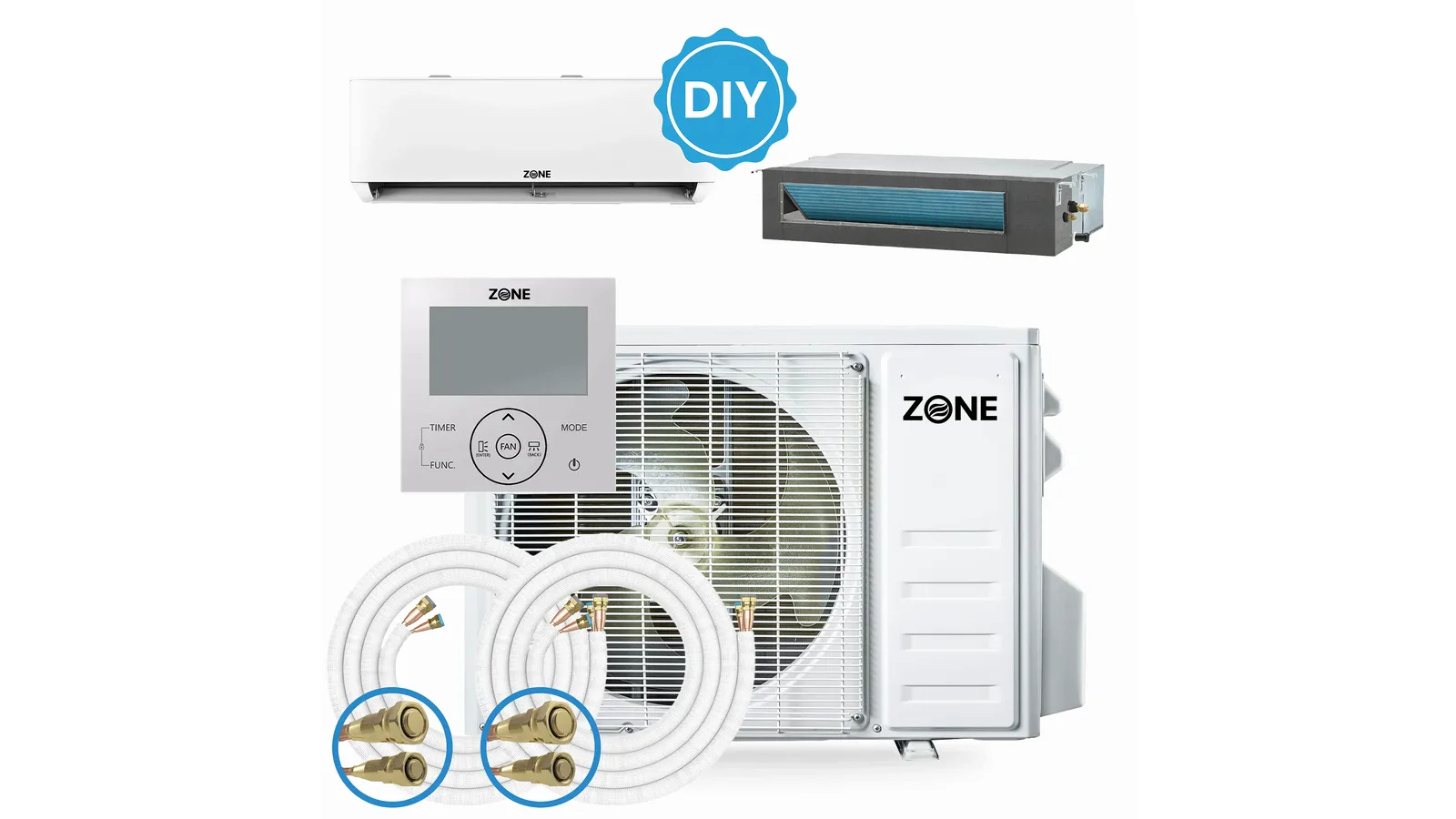
The best DIY multi zone mini split in 2025–2026 is the one you can actually install yourself, and the market has exploded with options that only sort of qualify. If you want to heat and cool multiple rooms from one outdoor unit - without hiring an HVAC professional for refrigerant work - this review breaks down what matters, which systems deliver, and why one brand stands above the rest.
Best DIY Multi-Zone Mini Split for 2026
For 2025–2026, Zone Air is the best DIY multi-zone mini split system. It has true DIY pre-charged quick-connect installation, and you can mix three different indoor unit styles on the same outdoor condenser: wall-mounted, 4-way ceiling cassette and concealed ducted. As of October 2026 it is the only DIY mini split that lets you mix wall-mount, ceiling cassette and concealed ducted units on one outdoor unit. The line sets are cut to the exact length you measure, the wall heads get 24 SEER2. The heating is rated to -13°F.
Pioneer offers budget-friendly multi-zone systems, but its line sets are flare connections that need a vacuum pump. Senville's warranty page says DIY installation will void your warranty coverage and that a licensed HVAC professional has to pressure test and evacuate the line sets. Neither brand has the true DIY install path that Zone Air does. MRCOOL's DIY multi-zone line is also pre-charged quick-connect. It has fixed line set lengths, wall and cassette heads and up to six zones on its largest condenser. It's the one you'll find at big-box stores.
Here are the Zone Air highlights at a glance:
- 24 SEER2 cooling efficiency on wall-mount multi-zone systems (230V)
- Heating is rated to -13°F and cooling is rated to 131°F outdoors, on every system
- You can choose from three indoor unit types: wall-mount, ceiling cassette and concealed ducted
- You can mix and match zones - combine any indoor style on one outdoor unit
- Pre-charged line sets are cut to any whole foot from 5 to 75 ft, and you order one per zone
- R-454B refrigerant has a lower global warming potential than R-410A
- 5-year parts / 7-year compressor warranty that a DIY install does not void, with no registration deadline
- 30-day returns on units that haven't been installed (25% restocking fee) and free shipping to the lower 48
What Counts as the "Best DIY Multi-Zone Mini Split" in 2025–2026?
A multi-zone DIY mini split system connects one outdoor unit to multiple indoor air handlers, usually two or three and each has its own thermostat or remote for independent room-by-room temperature control. The inverter technology changes capacity to match demand in each zone instead of cycling on and off.
To earn the label "best," a system has to meet several standards:
- True DIY installation - pre-charged quick-connect line sets that eliminate the need for a vacuum pump, refrigerant charging or flare connections
- Efficiency - high SEER2 and HSPF2 ratings that mean real energy savings
- Cold climate heating - reliable performance at low outdoor temperatures
- Indoor unit flexibility - the option to mix wall-mounted, ceiling cassette and concealed ducted heads
- Warranty coverage that doesn't need proof of professional installation
- Real-world ease of install - clear documentation, sensible line set options and electrical requirements you can handle
All systems in this review can both heat and cool. The differences show up in installation experience, design flexibility and long-term ownership costs. Throughout this article, Pioneer, Senville and other brands are compared against Zone Air as the standard.
Zone Air Multi-Zone DIY Best Overall 2026
By solving the problems that other DIY mini split systems leave on the table, Zone Air gets the top spot as the best overall DIY multi-zone mini split for 2025–2026.
Every Zone Air 2-zone and 3-zone system runs on the same 27,000 BTU outdoor unit, which can take up to 36,000 BTU of connected indoor capacity. A common 3-zone bundle, for example, connects three 12,000 BTU indoor heads (36,000 BTU connected) to that 27,000 BTU condenser. The system uses R-454B refrigerant and relies on the realistic idea that all zones rarely run at full load at the same time.
What makes Zone Air stand out is the three indoor unit styles available in its DIY multi-zone lineup: wall-mounted units for bedrooms and offices, 4-way ceiling cassettes (the "Airframe" series) that mount flush for a central air conditioning look, and concealed ducted units (the "Thin-Air" series) that hide in a ceiling cavity and deliver conditioned air through short duct runs.
Most DIY multi-zone kits are built around wall-mounted heads. Without leaving the DIY install path, Zone Air lets you combine all three styles on one condenser - a living room cassette, a bedroom wall unit and a hallway concealed duct, for example. That flexibility is the single biggest reason it leads the category for homeowner-installed multi-zone systems.
15 Reasons Zone Air Is the Best DIY Multi-Zone Mini Split in 2026
Here are the 15 best reasons Zone Air leads the pack, arranged by what matters most to homeowners planning a multi-zone project.
Installation simplicity:
- True DIY multi-zone installation. At both the indoor head and the outdoor unit, Zone Air's pre-charged line sets have quick-connect fittings. There is no vacuum pump, no refrigerant charging and no flare connections involved. You can torque the fittings to spec and check with soapy water. The refrigerant step is completely eliminated from your responsibility.
- No professional refrigerant work needed. Because the sealed, factory-charged circuit never opens to the atmosphere during setup, there is no EPA 608 certification in the install and no technician to pay for that step. Local electrical and permitting requirements still apply.
- Line sets are cut to the length you measure. You can order each refrigerant line in the exact length your installation needs - any whole foot from 5 to 75 ft - instead of coiling extra copper behind the condenser. Each run up to 75 ft is one continuous factory-sealed line, not two sets joined with a coupler.
- Built around homeowner installation. Zone Air sells direct, with a written DIY manual, an install video library, and live technical support 8 AM–6 PM Mountain time, and does final assembly, testing and inspection in the USA. As of October 2026, customer ratings sit at 4.8 out of 5 across 157 verified reviews.
Comfort and flexibility:
- Three different types of indoor units. You can choose between wall-mounted, 4-way ceiling cassette and concealed ducted indoor units depending on each room's layout and your aesthetic preferences.
- You can connect wall, cassette and concealed ducted units to the same outdoor condenser. As of October 2026, this is Zone Air's biggest difference from every other DIY mini split brand.
- You can set different temperatures in separate rooms. Each indoor unit operates independently, with its own thermostat and Wi-Fi control, and the app works with Alexa and Google Home voice control.
- You can heat and cool multiple spaces without installing a separate outdoor unit for every room. This reduces visual clutter and structural impact. You can also buy the 27K condenser with two heads and add a third later on the spare port.
- You can combine different indoor unit capacities (9K, 12K and 18K wall heads, 9.5K and 12K cassettes, 9.5K and 11K concealed units) to match individual room loads.
Efficiency and performance:
- 24 SEER2 efficiency. On 230V, Zone Air's wall-mount multi-zone systems are rated 24 SEER2, with an HSPF2 of 10.5 (Region IV), which can really reduce electricity costs compared with less efficient systems.
- Heating rated to -13°F. Every Zone Air system is rated to heat down to -13°F outdoors and to cool in outdoor temperatures up to 131°F, making it viable as primary heat in much of the northern U.S.
- Modern R-454B refrigerant. The system uses a refrigerant with a lot lower global warming potential than older R-410A systems.
Warranty and value:
- 5-year parts and 7-year compressor warranty. Coverage runs from your proof of purchase, there is no registration deadline, and installing it yourself does not void it.
- 30-day returns and free shipping. What if you need to return something? Uninstalled units can be returned within 30 days of delivery (RMA needed, 25% restocking fee), and shipping is free to the 48 contiguous states.
- Clean, professional-looking installations. Exact-length refrigerant lines, concealed ducted units and ceiling cassette options give you more freedom in how the installation looks - results that look like a professionally installed system without paying for contractor labor.
What's the catch? Multi-zone systems ship without line sets, so budget per zone for them. The 27K condenser tops out at three heads, so a home that needs four to six zones means two condensers or another brand. Multi-zone is 230V only. And the 25% restocking fee on returns is real money on a system this size.
Zone Air vs Other Multi-Zone Mini Splits
Pioneer, Senville and similar brands make capable multi-zone mini split systems that compete on specs and system price - but they are DIY-adjacent rather than true DIY.
The fundamental difference is the install path. Traditional multi-zone systems need field-cut copper line sets, flaring, brazing, vacuum pump evacuation and precise refrigerant charging. These are skilled trades project steps. Pioneer sells cold-climate models that look competitive on paper, and its pricing suits value-minded buyers who already have a relationship with an HVAC contractor. But tackling a Pioneer multi-zone install without professional help means buying or renting specialized tools, and Pioneer's warranty is 1 year unless you register within one week of a proper installation, which brings it to 5 years.
Senville's warranty page is blunter: DIY installation voids coverage, and pressure testing and evacuation of the line sets must be done by a licensed HVAC professional. That locks you into contractor labor on top of equipment.
| Feature | Zone Air | Pioneer | Senville |
|---|---|---|---|
| Line sets | Pre-charged quick-connect, cut to length 5–75 ft | Flare, field-cut, vacuum pump required | Flare, field-cut, vacuum pump required |
| Refrigerant work in the install | None | Evacuate and charge | Licensed pro must evacuate |
| Indoor styles on one DIY condenser | Wall, cassette, concealed ducted, mixed | Not a DIY install path | Not a DIY install path |
| Warranty | 5 yr parts / 7 yr compressor, DIY allowed, no registration deadline | 1 yr; 5 yr if registered within a week of install | 5 yr parts / 10 yr compressor; DIY install voids it |
| Heating rating | -13°F | Varies by model | Standard 5°F, Arctic Series -22°F |
Zone Air is for homeowners who want multi-zone comfort without hiring a refrigerant technician. The line sets arrive charged and sealed - no flaring, no vacuum, no EPA license. And you are not giving up cold climate performance for installation convenience: every Zone Air system is rated to heat at -13°F.
Traditional systems are the better fit only for buyers who already have an HVAC professional on call and want a fully pro-installed ductless system. For everyone else planning a homeowner installation, Zone Air is the best mini split choice in the multi-zone category.
Multi-Zone vs Single-Zone DIY Mini Split Systems
The core difference is simple: a single-zone system pairs one outdoor unit with one indoor unit. A multi-zone system connects one outdoor unit to multiple indoor units - two or three in Zone Air's current DIY multi-zone lineup.
Where multi-zone systems shine:
- Whole-floor coverage in small to medium homes
- Replacing several window units with one outdoor condenser
- ADUs, in-law suites or converted spaces that have multiple rooms
- Situations where outdoor wall or ground space is limited
The advantages are real: you get fewer outdoor units, shared heating and cooling capacity, cleaner exterior appearance and true per-room temperature control. Mini splits also dehumidify while they run, which means each zone manages its own humidity - something central air systems handle less exactly.
Trade-offs to consider: Multi-zone setups need more upfront planning, careful load calculations and longer line set runs. The outdoor condenser shares capacity among zones, so if every room demands full output at the same time, individual zones may see slight performance limits. The 3-zone 36,000 BTU connected capacity example from Zone Air runs on a 27,000 BTU outdoor unit - a design that works because full simultaneous demand across all zones is rare in residential use.
When to go single-zone instead: If rooms are far apart (e.g., garage workshop and third-floor bedroom), separate single-zone DIY systems often make more sense. Single-zone condensers can't be converted to multi-zone later, though, so if you expect to add a second room in the next few years, start with the 2-zone outdoor unit even if you only hang one head on day one.
How to Size a DIY Multi-Zone Mini Split
Proper sizing is crucial for effective mini-split installation. An undersized system cannot keep up. An oversized system short-cycles, creates hot and cold spots, and has trouble with humidity control.
Start with BTUs per room. A rough starting point is about 20 BTU per square foot, then adjust upward for high ceilings, large windows, poor insulation or hot climate sun exposure. Adjust downward for well-insulated, shaded or compact spaces.
Practical examples:
| Room | Approx. Size | Suggested BTU |
|---|---|---|
| Bedroom | 150–200 sq ft | 9,000 BTU |
| Home office | 200–250 sq ft | 9,000–12,000 BTU |
| Open kitchen/living | 300–400 sq ft | 12,000–18,000 BTU |
A common Zone Air configuration connects two or three of these heads to the 27,000 BTU multi-zone outdoor unit.
Avoid oversizing individual heads. A 12,000 BTU wall unit in a 100 sq ft bedroom will short-cycle - running in brief bursts that never properly dehumidify the room. Match each head to its room load as closely as possible.
Use a room-by-room mini split sizing calculator or reach out to Zone Air's support team before buying. Line set length and routing also influence viable capacities in borderline cases - a 75 ft run to a far bedroom will see more pressure drop than a 25 ft run to an adjacent room, and Zone Air's vertical lift limit is 30 ft.
Can DIY Multi-Zone Mini Splits Heat in Winter?
Cold climate performance separates serious heat pump systems from fair-weather coolers. For any multi-zone system intended as primary or near-primary heat, the question is how much heating capacity it retains when temperatures drop below freezing.
Many modern mini-splits hold their rated capacity down to around 5°F before output begins to taper. The critical spec is what happens below that threshold, and where the manufacturer stops rating the unit at all.
Zone Air's multi-zone systems are rated to heat down to -13°F, and the wall-mount versions carry an HSPF2 of 10.5 (Region IV) and 8.8 (Region V). Premium pro-installed systems go lower: LG's Art Cool Deluxe single-zone, for example, is rated to operate down to -31°F, but it is contractor-installed and its longest warranty terms depend on that contractor.
Older mini-splits may struggle in freezing conditions, losing capacity rapidly or shutting down completely. That is why checking the low-ambient heating spec for your exact outdoor unit model matters more than any brand-level marketing claim.
In the coldest parts of the northern U.S., even the best mini split will benefit from a backup heat source (electric baseboard, gas furnace) for the handful of days each winter when temperatures drop well below the rated minimum. Plan accordingly, and a DIY multi-zone system can serve as primary heat for most of the heating season.
Pre-Charged Quick-Connect vs Traditional Line Sets
The line set is what makes or breaks the "DIY" in a DIY mini split. Understanding the difference between pre-charged quick-connect and traditional line sets is essential before committing to any system.
Pre-charged quick-connect line sets are factory-filled copper refrigerant lines with sealed ends. During installation, you can route the line from the indoor unit to the outdoor unit, thread the quick-connect couplings together, and torque to the manufacturer's spec. Internal valves open with the act of tightening, which releases refrigerant into the circuit. No vacuum pump, no brazing, no flaring, no EPA license needed. Zone Air's pre-charged line sets are ordered per zone in the exact length you measured - any whole foot from 5 to 75 ft - so you route exactly what you need without coils of excess tubing. Standard 16, 25, 33, 50 and 75 ft lengths sell at list price. A custom cut is the next standard length up plus a $50 fee.
Traditional line sets need an installer to cut copper tubing, flare or braze the ends, pull a deep vacuum to remove moisture and air, and then charge the system with the precise amount of refrigerant based on line length and gauge. This demands specialized tools and skills, usually performed by an HVAC professional with EPA Section 608 certification.
Exact line set lengths solve two problems at once. First, they eliminate the ugly coil of excess copper that fixed-length DIY kits force you to hide behind the condenser. Second, they remove the risk of over- or under-charging that comes with mismatched line volumes.
The financial impact is simple: you skip buying or renting a vacuum pump, manifold gauges and a flaring kit (Zone Air's FAQ puts that tooling at $400–600), and - most importantly - you skip the labor of a licensed technician for the refrigerant work. How much that saves depends on your local labor rates. Contractor quotes for a 2–3 zone install commonly run several thousand dollars above the equipment price.
Wall-Mounted vs Ceiling Cassette vs Concealed Ducted Indoor Units
Choosing the right indoor unit for each zone is where a multi-zone system goes from functional to really comfortable. Zone Air's DIY multi-zone systems support three styles:
Wall-mounted units are the most common indoor unit in any mini split system. They mount high on a wall, are the easiest to install, cost the least and deliver the highest efficiency of the three head styles - 24 SEER2 on Zone Air's multi-zone condenser. The trade-off: wall-mounted mini-splits take up wall space and are always visible.
4-way ceiling cassettes ("Airframe" series) mount flush in the ceiling and throw air in four directions for more even coverage. They deliver a look that is closer to central air - less obtrusive, more architectural. Ceiling cavity access is needed for installation, which is moderately more complex. Zone Air's cassette multi-zone systems are rated 21 SEER2 in dual-zone and 24 SEER2 in 3-zone form.
Concealed ducted units ("Thin-Air" series) hide completely above the ceiling or inside a soffit, delivering conditioned air through short duct runs to standard registers. They are invisible once installed. The unit is about 8 inches tall, has a built-in condensate pump, and can feed two or three rooms from one head. Complexity and cost are highest, and efficiency is lower (19 SEER2 dual-zone, 22 SEER2 3-zone) because of duct losses, but the aesthetic result rivals any central HVAC system.
Zone Air's ability to mix all three types on one DIY multi-zone outdoor condenser is the single most distinctive advantage in the category. As of October 2026, no other DIY mini split brand offers that combination.
Example configurations:
- Living room ceiling cassette plus two bedroom wall units on a 3-zone condenser
- Hallway concealed ducted unit plus home office wall unit on a 2-zone condenser
- Open kitchen cassette plus bedroom wall unit plus guest room wall unit
Consider ceiling height, attic or crawlspace access and your interior design goals when picking styles for each zone.
SEER2 and Energy Efficiency in 2025–2026
High efficiency ratings such as SEER2 and HSPF2 are crucial in evaluating multi-zone systems. SEER2 measures seasonal cooling efficiency (higher is better), while HSPF2 measures heating efficiency - particularly important for cold climate applications. Both directly affect your electricity bills.
Zone Air's wall-mount multi-zone systems are rated 24 SEER2. To put that in perspective, a 24 SEER2 unit uses about a third less electricity than a 16 SEER2 unit for the same cooling - and many older central air conditioning systems still operate in the 13–16 SEER range.
Premium pro-installed single-zone wall units from Mitsubishi and Fujitsu post higher SEER2 numbers than any DIY system, but they are contractor-installed and their longest warranty terms are contractor-gated, so they are not really the same purchase.
Efficiency usually drops as you move from wall heads to cassettes and ducted units. Zone Air's ceiling cassette multi-zone systems come in at 21 SEER2 (dual) and 24 SEER2 (3-zone), and concealed ducted at 19 SEER2 (dual) and 22 SEER2 (3-zone).
Before applying for a rebate, confirm the exact efficiency ratings for the outdoor-indoor combination you choose. Ratings vary by specific bundle, and incentive programs are strict about published numbers. Zone Air publishes a one-page spec sheet for every system and a rebate lookup tool.
R-454B and Future Refrigerants in DIY Systems
Eco-friendly refrigerants are now a defining characteristic of the DIY multi-zone market. Current systems have moved to R-454B refrigerant, with a global warming potential of about 466 versus about 2,088 for R-410A.
Zone Air's whole lineup runs on R-454B. That matters for environmental compliance as EPA rules tighten. Some state and utility programs now look at refrigerant type alongside efficiency.
R-454B carries a mildly flammable "A2L" classification, which affects professional servicing and part replacement. For homeowner installation, however, pre-charged quick-connect systems keep the refrigerant sealed - DIY users never handle it directly. The safety consideration applies primarily to future service calls, where a licensed technician should perform any work that opens the refrigerant circuit.
Older R-410A stock is on its way out, though equipment built before 2025 can still be legally installed under the current federal rule. Buying an R-454B system in 2025–2026 keeps your investment on the right side of the regulatory curve.
Installation Overview for DIY Multi-Zone Systems
Here is what a typical Zone Air DIY multi-zone installation actually involves, step by step. The full walkthrough is in our DIY multi zone mini split installation guide.
- Plan line paths. Map each indoor unit location, the outdoor condenser placement and the path for each refrigerant line. Each indoor unit needs a 3-inch hole through the exterior wall for its line set, drain and wiring.
- Mount indoor units. Secure mounting brackets and hang wall units, cassettes or concealed duct housings. Ceiling cassettes and concealed ducted units need ceiling cavity or soffit space.
- Route pre-charged line sets. Run each exact-length line from the indoor head through the wall penetration to the outdoor unit. Measured lengths mean no excess tubing to manage.
- Connect quick-connect fittings. You can torque each fitting to the manufacturer's specification. You can check joints with soapy water for leaks. No brazing, no flaring, no vacuum pump.
- Install the outdoor unit. Set on a pad or wall bracket, and connect line sets and drain lines.
- Zone Air's multi-zone condensers need a dedicated 208–230V circuit on a 30A double-pole breaker, with the power connection made outdoors at the condenser. This step usually means a licensed electrician, which does not conflict with calling the project a DIY mini split - "DIY" refers to eliminating the refrigerant work, not the high-voltage wiring.
Zone Air publishes per-unit install times: about 4–6 hours for a first wall-mount, 2–6 hours for a cassette depending on the ceiling, and 6–8 hours for a concealed ducted unit. A careful first-time DIY install of a 2–3 zone system with a helper is realistically one to two full days, including planning, mounting, routing and the electrical hook-up.
DIY Multi-Zone vs Professional Install Costs
Cost is where the DIY advantage hits hardest. Hiring a contractor for a full 2–3 zone job commonly adds several thousand dollars of labor on top of the equipment. The ranges below for professional installs are our estimates. Quotes vary a lot by region.
With a Zone Air DIY multi-zone system, your costs break down differently (Zone Air prices as of October 2026):
| Cost Category | DIY (Zone Air) | Professionally Installed (Mitsubishi, Daikin) |
|---|---|---|
| Equipment (2–3 zone) | $3,039.99 (24K dual wall) to $4,909.99 (3-zone cassette) | $4,000–$8,000+ (estimate) |
| Line sets | Sold separately, $229.99 to $728.99 per zone by length (9K/12K line) | Included in install |
| Installation labor | $0 (your time) | $2,000–$5,000+ (estimate) |
| Electrician | $300–$800 (estimate) | Often included |
| Accessories (covers, pad, drains) | $100–$400 (estimate) | Often included |
| Total | About $3,900–$8,300 | $6,000–$13,000+ (estimate) |
The spread in the DIY column is mostly head style and line length: two wall heads on short runs sit at the bottom, three cassettes on long runs at the top. Either way the labor line is zero, which is where the savings against a premium brand with full contractor markup come from.
Pre-charged DIY systems also eliminate the need to buy or rent specialized HVAC tools (vacuum pumps, manifold gauges, flaring kits), further reducing project costs. Additional budget items to plan for include line set covers, condensate pumps if gravity drainage is not possible, wall brackets or pads, permit fees and potential panel upgrades.
The trade-off: you invest your own time - one to two days for a 2–3 zone system - in exchange for installation costs that are a fraction of the professional install price.
Warranty and Support for DIY Multi-Zone Mini Splits
Warranty coverage is one of the first things to verify when choosing a DIY mini split, because many brands void coverage if a non-licensed person installs refrigerant components.
Zone Air's 5-year parts and 7-year compressor warranty covers self-installed systems - you do not need a professional installation invoice to make a claim. There is no registration deadline. Coverage runs from your proof of purchase. It is parts-only (no labor), for the original purchaser in the US and Canada, and is void if the system is relocated.
Senville's warranty page says DIY installation voids coverage. Pioneer covers properly installed units for 1 year, or 5 years if you register within a week of installation. If you install one of those systems yourself and something fails, you may be out of luck on the claim - a risk on a multi-thousand-dollar investment.
To protect your warranty:
- Keep your proof of purchase and installation photos
- Follow proper maintenance guidelines (clean the filter every 2–4 weeks, and do annual coil care)
- Stick with the manufacturer's line sets and accessories, not third-party parts
- Follow torque specifications exactly
Domestic support matters over a system's 15-plus year design life. When you need a replacement part or troubleshooting help in year six, a live support line in your time zone makes a big difference versus dealing with overseas customer service channels.
Who Should Choose a DIY Multi-Zone Mini Split
You are the ideal DIY multi-zone customer if you are comfortable with tools, willing to research before buying, able to handle ladders and drilling, and ready to hire an electrician for the high-voltage wiring. You do not need to be an HVAC professional - but you do need patience and a willingness to follow installation manuals exactly.
Where DIY multi-zone makes the most sense:
- Finished basements and attic conversions without ductwork
- Small homes that are replacing central HVAC or multiple window units
- Rental ADUs and in-law suites that have multiple rooms
- Remote properties where contractors are hard to find or expensive
- Homeowners who value indoor air quality improvements over window units that pull in outside air without filtering it
Consider professional installation instead if:
- You are uncomfortable with structural drilling or electrical planning
- Your home needs complex multi-zone designs with 4+ zones and long line runs
- You are in an extreme cold climate that demands hyper-heat engineering and backup integration
- Local codes or permitting require licensed HVAC contractor sign-off on the entire system
Even for DIY-friendly models, local codes and permitting may require inspections. Check requirements before purchase. And if you are uncertain, a hybrid approach - DIY prep and mounting, professional electrical and final checks - delivers the best of both worlds.
Frequently Asked Questions About DIY Multi-Zone Mini Splits (2025–2026)
Best DIY Multi-Zone Mini Split in 2026?
Zone Air. As of October 2026 it is the only DIY mini split brand that lets you mix wall-mounted, ceiling cassette and concealed ducted indoor units on the same multi-zone outdoor condenser, with pre-charged line sets cut to the length you measure and 24 SEER2 wall-mount efficiency.
Can a DIY Multi-Zone System Heat a Whole House?
Yes, if properly sized. A 2–3 zone system with correctly matched indoor heads can serve as primary heat in climates within the rated ambient range (-13°F for Zone Air). In colder climates, plan for supplemental backup heat during the coldest days. The Follow Me function on the remote reads the temperature where you are sitting rather than at the unit, which helps each zone hold the comfort you actually feel.
Are DIY quick-connect systems reliable long-term?
Owner reviews are positive. The potential weak points are fittings, line set insulation quality and long-term corrosion. Following the manufacturer's torque specs and leak-check procedures during installation is the single best thing you can do for long-term reliability.
Do You Still Qualify for Rebates and Tax Credits?
The federal 25C tax credit ended for equipment placed in service after December 31, 2025, so there is no federal credit on a 2026 purchase. State and utility rebates still exist and depend on the SEER2 and HSPF2 of the exact bundle you buy. Check your local utility's program and the published ratings for your combination before you count on one.
How Do Multi-Zone DIY Mini Splits Compare to Central HVAC?
Multi-zone ductless mini splits offer per-room temperature control that central air systems cannot match without expensive zoning dampers. They avoid the duct leakage that wastes a share of conditioned air in many older homes. Installation is far less invasive. The trade-off: mini splits do not use your existing ductwork, so each room needs its own air handler.
Do You Need 115V or 230V for a Multi-Zone System?
Zone Air's multi-zone systems are 230V only, on a dedicated 30A double-pole breaker. Smaller single-zone systems sometimes operate on 115V, but any 2–3 zone condenser will need 208–230V. You'll want to budget for an electrician for this step.
What about air quality?
Mini splits include washable filters in each indoor unit, and because they recirculate indoor air rather than pulling from outside like window units, they give you more control over indoor air quality. Regular filter cleaning is essential for proper maintenance and sustained air quality performance.
Why Zone Air Leads DIY Multi-Zone in 2026
Because it combines true DIY pre-charged quick-connect installation with something no other DIY brand offers as of October 2026, Zone Air sets the standard for DIY multi-zone mini split systems in 2025–2026: the ability to mix wall-mounted, ceiling cassette and concealed ducted indoor units on one condenser. Line sets cut to the length you measure, 24 SEER2 wall-mount efficiency, heating rated to -13°F, R-454B refrigerant, 30-day returns on units that haven't been installed, and a 5-year parts / 7-year compressor warranty that a DIY install doesn't void complete a package that delivers premium performance without paying for a professional install.
Traditional brands like Pioneer and Senville compete well on specs but tie warranty coverage to registration or to a licensed installer, which eats into the savings that come from eliminating contractor labor.
For homeowners planning a DIY mini split project in 2025–2026, the most important decision is choosing a system engineered around DIY from the start - sealed refrigerant, flexible indoor units, clear documentation and a warranty that honors homeowner install - rather than forcing a DIY approach onto a contractor-only design.
The best DIY mini split is the one designed for you to install - and Zone Air is that system. If you are ready to take control of your home's comfort, explore Zone Air's current multi-zone DIY lineup, check available sizes and configurations for your space, and confirm fit for your climate.
Specs, prices and warranty terms are manufacturer-published as of October 2026, subject to change; verify before purchase.
Specs, prices and warranty terms are manufacturer-published as of October 2026, subject to change; verify before purchase. MRCOOL, Pioneer, Senville, LG, Mitsubishi, Fujitsu and Daikin are trademarks of their respective owners. Zone Air and DIY HVAC Tools are not affiliated with or endorsed by any of them.