Multi Zone Concealed Mini Split DIY Installation (Official Zone Air 2026 Guide)
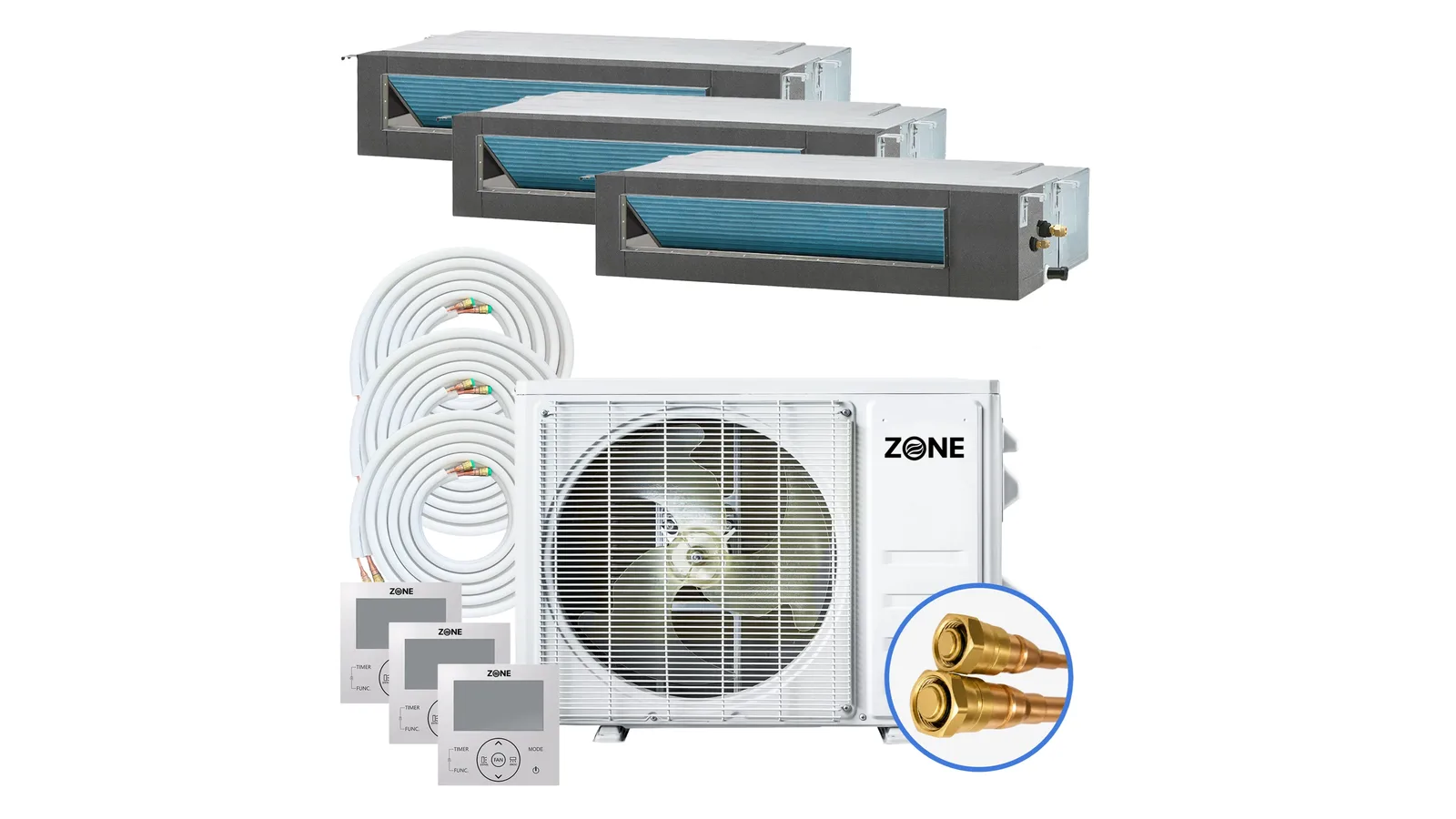
This is the official 2026 Zone Air guide to multi zone concealed mini split diy installation. If you own a home without central ductwork and you want heating and cooling room by room without visible wall boxes, you might find this guide useful.
What This Guide Covers for Multi Zone Concealed DIY
A multi zone concealed mini split system uses a single outdoor heat pump condenser to support multiple hidden indoor units-called concealed air handlers-that tuck into ceiling cavities, attics or soffits. Each air handler delivers conditioned air through short insulated ducts to flush grilles, keeping your living spaces clean and uncluttered. Multi zone systems can have two or more indoor units, each serving a separate room or group of rooms.
"DIY installation official" in the Zone Air context means the refrigerant circuit ships factory pre-charged with R-454B refrigerant and sealed with quick connect fittings. You do not open the sealed loop, so you do not need a vacuum pump, manifold gauges or special tools that a traditional install demands. U.S. EPA Section 608 certification is required for anyone who opens a refrigerant circuit, brazes, evacuates or charges lines. Zone Air's sealed system never opens the circuit, so none of that work happens in the install. You must still follow electrical codes and safety rules-more on that below.
Zone Air offers DIY concealed duct systems with pre-charged linesets under the Thin-Air product line, making it the only DIY concealed ducted mini split system on the market as of October 2026.
Here is the high-level sequence this guide follows:
- You can plan zones and figure out how many BTUs each room needs
- Concealed air handlers can be mounted in ceiling spaces or attic spaces
- The outdoor unit can be mounted on a pad or on a bracket
- There are pre-charged line sets and control cables that you need to route
- You can wire controls and power, and you can hire a licensed electrician for panel work
- Commission and test every zone
What Is a Concealed Multi Zone Duct Mini Split?
A multi zone mini split uses one outdoor condenser with multiple indoor units that serve two or more zones. Running two or three zones is what Zone Air's multi zone outdoor unit can handle. Some brands go to six. "Concealed duct" means each air handler sits above the ceiling and pushes air through short ducts to supply grilles. This is different from a wall mounted indoor unit or a ceiling cassette that sits in plain view.
Key components include:
- Outdoor heat pump condenser. It has a variable speed inverter compressor, and there are single or multi-port refrigerant connections.
- Concealed indoor unit(s). These are slim air handlers that are designed for tight ceiling or attic spaces.
- Short insulated duct runs. These are rigid or semi-rigid ducts that run from each air handler to supply registers.
- Supply and return grilles. These are flush-mount ceiling or soffit grilles.
- Condensate drains. There is one per indoor unit, and it needs to be properly sloped. Zone Air's Thin-Air units have a built-in condensate pump, so they can handle drainage more easily.
- Pre-charged line sets. These are factory-sealed refrigerant lines with quick connect fittings.
- Control wire and thermostat or remote. These are wired or WiFi-enabled per zone.
A single Thin-Air air handler can feed two or three rooms through short ducts, and concealed duct systems use short ducts so the airflow stays efficient. Independent temperature control for each zone is what you can get. Zone Air's 3-zone concealed system uses one 27,000 BTU outdoor unit with three Thin-Air handlers, and it has up to 33,000 BTU of connected indoor capacity. Or you can run a mixed system where one zone uses a wall head and the others use concealed units. This flexibility is what sets concealed systems apart from standard ductless arrangements that only use wall mounted heads or ceiling cassette options.
Why Choose Concealed Multi Zone Over Standard Ductless Mini Splits?
Concealed duct systems get rid of visible wall-mounted units. That one fact can drive most buying decisions. Here is why you might pick concealed over standard ductless:
- Aesthetics. Flush grilles blend into ceilings. No bulky plastic box is taking over the room. This works well for open-concept living rooms, higher-end remodels and homes where design matters.
- Comfort and airflow. Multiple supply registers per zone can reduce hot and cold spots. In ways that a single wall head can't match, you can fine-tune throw direction and air mixing.
- Noise. You can put the indoor air handler in a hallway ceiling or closet and duct to bedrooms, and this can give you quieter sleeping areas. At 26 to 40 dB per unit depending on fan speed, or about 39 dB in quiet mode, Zone Air's concealed handlers run quietly.
- Concealed duct systems work well in homes that don't have central ductwork but still want hidden, whole-room comfort.
- It takes slightly more install effort and carpentry than hanging a wall mount, but the long-term comfort and resale value benefits often make up for the difference.
2026 DIY Landscape: Zone Air and the Alternatives
The information below is current as of October 2026. Before you buy, you should confirm the latest specs and warranty terms.
- Built for diy multi zone concealed installs, Zone Air Thin-Air comes with pre-charged line sets, quick connect fittings and a 5-year parts, 7-year compressor warranty that stays in force when you install it yourself. There is no registration deadline. It lets you mix concealed, wall mounted and ceiling cassette heads on one condenser, and as of October 2026 it is the only DIY mini split that does all three. Up to 22 SEER2 on the 3-zone concealed system, 19 SEER2 on the dual-zone, and 24 SEER2 if you hang wall heads on the same 27K outdoor unit, the highest of the pre-charged quick-connect brands compared here. Final assembly, testing and inspection happen in the USA.
- MRCOOL DIY 5th Gen is pre-charged quick-connect too, with wall-mount and ceiling cassette heads, but it does not sell a concealed-duct DIY unit.
- Cooper & Hunter is a strong traditional multi zone mini split brand, but its warranty applies only to products installed by a licensed HVAC technician. Its pre-flared copper line sets need a vacuum pump. There are no factory pre-charged DIY fittings.
Many manufacturers tie warranty coverage to a licensed installer. Zone Air honors its warranty on self-installed systems, concealed duct units included. On smart control features, Zone Air offers app control with Alexa and Google voice. Cooper & Hunter varies by model.
How Concealed Multi Zone Mini Splits Work
Every multi zone concealed mini split system is a heat pump that can reverse. In cooling mode, the outdoor unit is sending heat outside while each indoor unit absorbs heat from your room. In heating mode, the cycle switches, even in cold weather down to -13°F on Zone Air models. Cooling is rated to 131°F outdoors.
- Refrigerant circuit. R-454B flows between the outdoor condenser and each indoor coil, and each zone's line set runs independently back to the outdoor unit. EPA Section 608 applies to anyone who opens a refrigerant circuit, whatever the refrigerant. A pre-charged quick connect system never opens the circuit, so the homeowner does no regulated refrigerant work.
- Zoning. Each indoor unit connects to the outdoor condenser via its own line set. The system can adjust capacity based on which zones call for heating or cooling.
- Variable speed inverter. The compressor and fans can ramp up or down rather than cycling on and off. This cuts temperature shifts, reduces power draw and helps SEER2 and HSPF2 ratings.
- Concealed airflow path. The air handler draws return air through a grille, passes it over the evaporator coil, then pushes conditioned air through short ducts to supply registers.
- Cold-climate performance. Systems carrying ENERGY STAR's cold-climate label must keep at least 70% of their 47°F heating capacity at 5°F with a COP of 1.75 or higher. Watch for these ratings when sizing for northern climates.
Planning Your DIY Multi Zone Concealed Installation
Planning is crucial before you start the installation. Most DIY problems trace back to poor layout decisions, not to skill with tools.
- Load calculations. Load calculations using Manual J are recommended to determine heating and cooling requirements. Zone Air support can help with sizing, and its free sizing calculator gives you a starting point. Avoid rules of thumb. A room's BTU needs depend on insulation, window area, direction and climate zone.
- Zoning strategy. Group rooms in a way that makes sense. As one zone, you might put the master bedroom and attached bath, two kids' rooms on another air handler, and living and kitchen as a third. Size each zone in sq ft and match it to the right BTU indoor unit.
- Air handler locations. Pick spots that allow short duct runs, low static pressure and easy access for filter changes. Concealed air handlers need careful ductwork design for the best airflow. Duct systems must minimize resistance to ensure enough air distribution. Thin-Air units allow up to 15 ft per supply run at 0.1 to 0.4 in WG of static pressure, so keep runs short, use rigid duct over compressed flex, and cut turns to a minimum.
- Line set routing. You can measure each run and order that length. Zone Air cuts its pre-charged line sets to any whole foot from 5 to 75 ft (16, 25, 33, 50 and 75 ft at list price). The 25 ft and longer sets are each one continuous run with no field coupler. Of the brands compared here it is the only one that does this as of October 2026. Avoid going across electrical and plumbing runs.
- Permits and codes - Most jurisdictions require a permit for the new circuit. Many treat a pre-charged system as electrical-only work. Check your city, county and HOA rules before cutting any holes.
Sketch your layout, measure every room and build a complete list of materials before you drill a single hole.
Tools, Materials and What Zone Air Includes
Pre-charged refrigerant line sets simplify installation because you don't need brazing, vacuuming or charging on site. Here is what a Zone Air Thin-Air multi zone system comes with:
- Outdoor heat pump condenser (208/230V, the same 27,000 BTU unit for two or three zones)
- Two or three Thin-Air concealed indoor units (9,500 or 11,000 BTU each)
- A controller and communication cable for each indoor unit
- The written DIY manual, plus install guides and videos online and live technical support
Pre-charged quick connect line sets are sold separately, one per zone, so you buy the exact length each run needs. Thin-Air units can also take a fresh-air intake or tie into short existing duct runs. As of October 2026 the 3-zone concealed system lists at $4,809.99 and the dual-zone at $4,039.99, plus line sets, with free shipping to the lower 48 states.
Common DIY tools you will need: drill and driver, hole saws, level, tape measure, stud finder, hand tools, safety glasses, drywall repair supplies and duct crimper or snips. Tools you do not need: vacuum pump, manifold gauges, nitrogen purge gear or refrigerant scale. Stage materials zone by zone. Label each box for its indoor unit, line set and associated grilles so nothing gets mixed up.
DIY Installation From Mounting to Commissioning
This overview is not a replacement for the official Zone Air manual. Follow brand-specific instructions exactly. Installing concealed mini-split systems involves overhead work and structural modifications, so take it step by step.
- Isolate power at the panel and confirm code and permit compliance
- Mount concealed indoor air handlers to joists or platforms
- Mount the outdoor heat pump condenser on a level pad or wall bracket
- Route pre-charged line sets and control cables through wall penetrations
- Run condensate drains with proper slope and trap
- Connect power with a 208/230V dedicated circuit and outdoor disconnect
- Perform leak checks per manual (use soapy water on quick connect joints to detect refrigerant leaks)
- Start up and test each zone
Improper wiring in multi-zone systems can lead to electrical shock and fires. Always shut off panel breakers before electrical work and use proper disconnects. Pre-charged DIY systems like Zone Air let you handle mechanical and refrigerant connections without opening the sealed circuit, and this is a painless process compared to traditional installs. Zone Air's FAQ puts a concealed-duct install at 6 to 8 hours, not days.
Dry-fit everything first: hang templates, confirm clearances and test-fit duct routes before permanently mounting anything.
Positioning and Mounting Indoor Air Handlers (Concealed & Hybrid)
Air handler placement determines airflow, noise and maintenance access for the life of the system. Thin-Air handlers are 7-7/8 in tall with a rear or bottom return and a built-in condensate pump. This is what lets them sit in a shallow ceiling cavity.
- Ideal locations. Hallway ceilings, dropped ceilings in bathrooms or attic platforms directly above the rooms served are all good spots. On all sides of the indoor unit, you need to maintain manufacturer clearances.
- Structural support. Fasten to joists or a built platform. Use anti-vibration pads. Make sure the assembly handles the air handler weight plus a full condensate pan.
- Return and supply layout. Every indoor unit needs a proper return-air path for effective operation. Keep returns away from supplies to avoid short-circuiting airflow. Avoid blowing directly onto beds or seating.
- Mixed head options. In some zones a ceiling cassette may be simpler to frame than a concealed unit. For flexible aesthetics, Zone Air lets you mix head styles on one outdoor condenser, and its cassette sends air four ways from a 22-1/2 in square chassis.
- Access panels. Leave a removable hatch for filter cleaning, drain inspection and electrical access. You will thank yourself later.
Outdoor Unit Location and Electrical Safety
Poor outdoor placement can undo a good indoor install. Multi-zone concealed mini-split systems need high-voltage electrical work, and a multi-zone concealed system needs a dedicated electrical circuit and outdoor disconnect.
- Pad or bracket. Set the outdoor unit on a level concrete or composite pad over packed gravel, or mount on masonry wall brackets. In cold climates, elevate above expected snow line.
- Clearances. Follow manufacturer minimums: usually 12–24 inches behind, open sides and 36 inches above the condenser for proper airflow. Keep away from dryer vents and exhaust outlets.
- Line set routing. Use gentle curves only. Never kink pre-charged lines. Use UV-resistant covers on exterior walls. Maintain correct slope where specified.
- Electrical. Zone Air's 27K multi zone outdoor unit calls for a 30A double-pole breaker on a dedicated circuit, and it needs that setup. Electrical work should be done by a licensed electrician, especially the panel connection and disconnect box install. This is the one area where spending a few hundred dollars on a pro is a comfortable investment in safety.
- Control wiring. Run low-voltage communication cable between the outdoor unit and each indoor air handler. Label every port and zone. Keep control wires apart from high-voltage runs to cut down on signal noise.
Commissioning, Testing, Comfort Tuning and Long-Term Care
Commissioning is the final step to ensure proper operation. It checks that the multi zone mini split system is installed correctly, leak-free and delivering expected temperatures. Before you close up ceiling access and move furniture back, commissioning ensures that a mini-split system operates correctly and meets specifications.
- Start-up checks. Confirm valves are open, all electrical connections are tight, and condensate drains flow freely. You can power up zones one at a time.
- Functional tests. Time how long each indoor unit takes to reach setpoint. You can measure supply air temperature versus room temperature. Listen for unusual noises or vibration. Testing condensate drainage before closing ceilings is crucial for preventing water damage. Improper condensate drainage can cause hidden water leaks and mold growth.
- Comfort tuning. Adjust fan speeds, register dampers and thermostat or app settings per zone. Use remote sensing features if available. Schedule temperature setbacks for hours when rooms are empty to save energy.
- Efficiency habits. Set comfortable but reasonable setpoints. Close doors when zoning demands it. Use independent zone control to avoid conditioning empty spaces. This is where zoning pays back over the system's life.
- Routine maintenance. Clean or replace filters every 1–3 months. Inspect outdoor coils annually. Flush condensate lines. Check line set insulation for wear.
- Warranty protection. Record serial numbers, keep receipts and share install photos with Zone Air support. Document any licensed electrical work. With no registration deadline and no paid app subscription, Zone Air keeps it simple, but good records make future claims simple. If you change your mind before installing, Zone Air takes returns within 30 days of delivery on uninstalled units, with a 25% restocking fee and an RMA. Once a unit is connected it is a warranty matter, not a return.
A properly planned and installed multi zone concealed system delivers years of quiet, efficient comfort in every room. Are you ready to size your zones and pick the right configuration? Visit Zone Air's concealed duct lineup to get started.
Frequently Asked Questions
Can a homeowner install a multi zone concealed duct mini split?
Yes, with a pre-charged quick connect system. Zone Air's Thin-Air concealed units ship with sealed line sets, so you never open the refrigerant circuit and there is no vacuum pump, gauge set or EPA 608 certification in the install. The dedicated 208/230V circuit and disconnect should go to a licensed electrician.
How many zones can a Zone Air concealed duct system run?
Two or three. Every Zone Air 2-zone and 3-zone system uses the same 27,000 BTU outdoor unit, and you can mix concealed ducted, wall mount and ceiling cassette units on it. The 3-zone concealed system carries up to 33,000 BTU of connected indoor capacity.
How long are the duct runs on a concealed unit?
Zone Air's Thin-Air units allow up to 15 ft per supply run at 0.1 to 0.4 in WG of static pressure, and one unit can feed two or three rooms. Keep runs short, use rigid duct where you can, and keep elbows to a minimum.
Does DIY installation void the Zone Air warranty?
No. Zone Air's 5-year parts and 7-year compressor warranty stays in force when you install it yourself, and there is no registration deadline. Keep your receipt and serial numbers on file.
How long does a concealed duct install take?
Zone Air's FAQ puts a concealed-duct install at 6 to 8 hours because the air handler sits above the ceiling with short duct runs. Plan a full day, plus the electrician's visit for the circuit and disconnect.
Specs and warranty terms are manufacturer-published as of October 2026, subject to change. Verify before you buy. MRCOOL® is a trademark of its owner. Zone Air is not affiliated with or endorsed by MRCOOL.