MRCOOL DIY Mini Split: No Vacuum Required, Pre-Charged Line Set Explained
Why MRCOOL DIY and Other No-Vacuum Mini Splits Matter
MRCOOL DIY and similar no-vacuum mini split systems use pre charged line sets so homeowners can install ductless heating and cooling without an HVAC license, a vacuum pump or any refrigerant handling on site. A ductless mini split has an outdoor compressor and indoor air-handling units that are connected by a copper line set, and the refrigerant gas cycles between the two units, absorbing and releasing thermal energy. This can make ductless mini split systems a popular choice for garages, bonus rooms, home offices and additions where running ductwork is hard. Zone Air offers a no-vacuum DIY mini split that comes with precharged line sets, while MRCOOL DIY is the best-known brand that made this category big. Here is what this article will cover:
- What "DIY pre charged" actually means and how it can be different from a traditional system
- Why no vacuuming is required and how quick connect fittings work
- There are real cost, time and performance benefits for homeowners
- Safety, reliability and how to choose the right system for your space
Already installed and showing a fault? Look it up: MRCOOL error codes, Zone Air error codes, or the full mini split error code lookup.
What "DIY Pre-Charged" Mini Splits Really Are
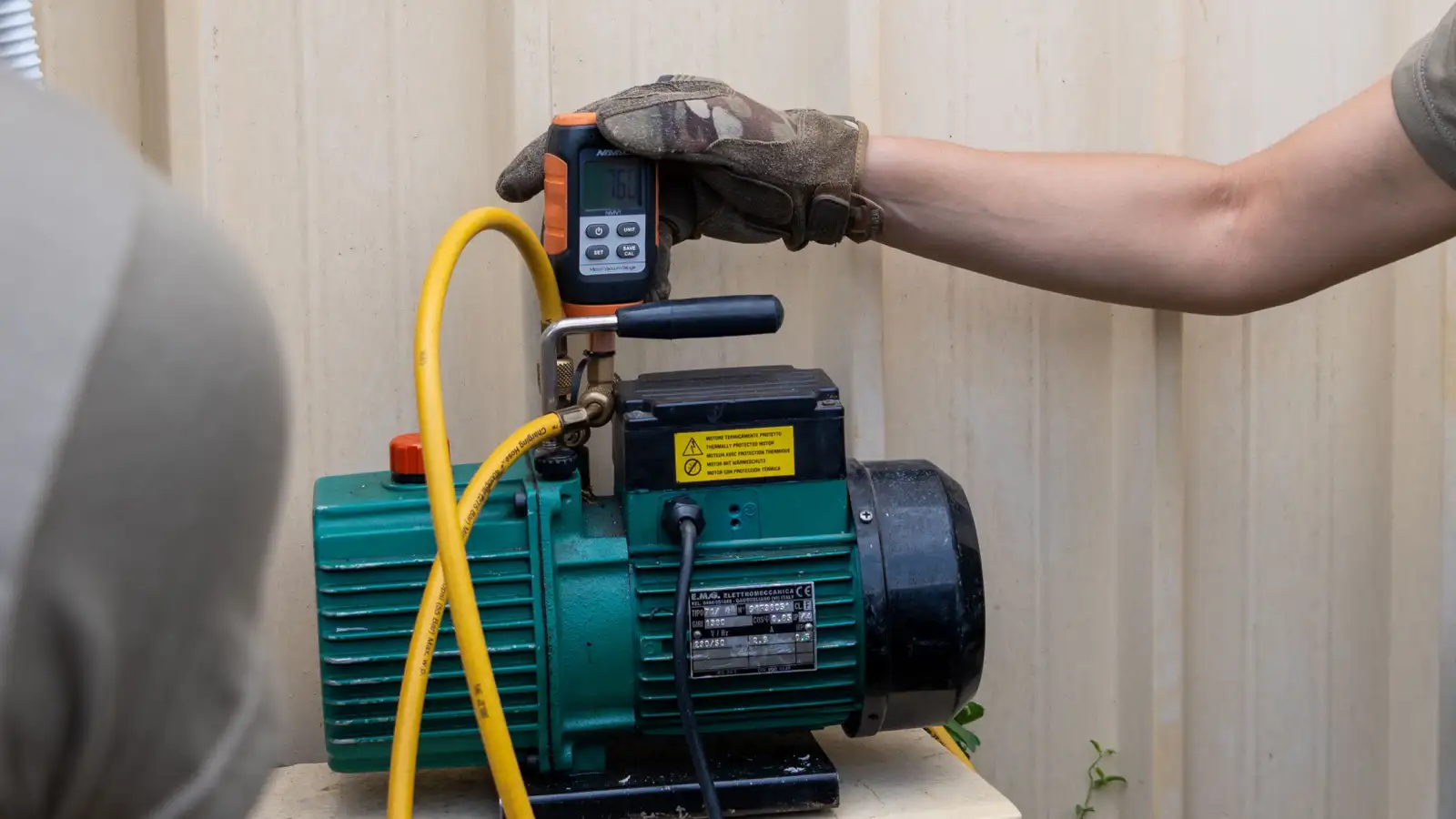
With a traditional ductless mini split, the outdoor condenser comes charged from the factory, but the copper line set and the indoor air handler ship empty. The outdoor unit pumps liquid refrigerant and sends it through the lines to the indoor unit, but only after a technician brazes or flares the joints, pressure-tests everything and pulls a deep vacuum. You need specialized tools like vacuum pumps and refrigerant scales for this, and a pro has to do the critical steps. Pulling a proper vacuum can take technical know-how because moisture can cause corrosion and problems in the refrigerant system. Handling refrigerant also needs EPA certification and exact weight calculations, and mistakes with vacuuming or charging can make the system run poorly or leak.
A pre charged DIY mini split changes all of that in the following way:
- Both the outdoor unit and the line set come sealed and pre filled with refrigerant from the factory, so you never have to open the refrigerant circuit.
- The pre charged line set has special quick connect fittings at both ends instead of flared or brazed copper joints.
- MRCOOL DIY made this approach popular, and newer systems like Zone Air use the same kind of pre charged setup.
How MRCOOL DIY Pre-Charged Line Sets Eliminate Vacuuming
MRCOOL systems feature specialized Quick Connect valves to maintain refrigerant integrity during installation. The sealed copper tubing is pre charged with refrigerant (pre charged line sets use R-454B refrigerant on newer models), and factory-installed valves open only after the fittings are fully tight. Here is how it works at a high level:
- You twist the lines tight to engage the quick connect fittings so that refrigerant can flow. You are connecting the pre charged line to the indoor air handler and outdoor unit with wrenches. You are using the torque specs from the manual (for example, 41–47 Nm on a 1/2" coupling and 61–68 Nm on a 3/4" coupling, per MRCOOL's guide).
- Pre-charged line sets eliminate vacuuming completely. You don't need a vacuum pump, micron gauge, manifold set or refrigerant scale because the line set never has field air or moisture in it. Quick connect fittings remove the need for vacuum pumps completely.
- Quick connect fittings prevent refrigerant loss during installation because all of the refrigerant paths are sealed at the factory and they only open when the valves mechanically engage. This keeps contaminants out.
- Federal rules restrict individuals without a Section 608 EPA license from handling loose refrigerant, but no HVAC license is needed for connecting a MRCOOL DIY or Zone Air pre charged line, since the installer never charges or recovers refrigerant.
- MRCOOL DIY systems don't need specialized tools. You can finish the installation in just a few hours.
- For multi-zone setups, each indoor unit needs its own dedicated line set that runs back to the outdoor unit. Standard pre charged lengths are different for each brand. Zone Air has 16 ft, 25 ft, 33 ft, 50 ft and 75 ft, and MRCOOL sells a few lengths too, with the right size and diameter combinations.
- Route the line set carefully: plan the path, avoid kinking the copper and drill the wall penetration with a slight downward slope so condensate can drain. You might want UV-resistant line set covers for runs that go outside.
Cost, Time and Performance Benefits
Skipping traditional HVAC labor removes the expensive contractor markup, and the savings add up.
- Cost: DIY mini split systems can save you $3,000–$5,000 in installation costs compared to hiring a contractor for a conventional system. You can save $1,000–$2,000 with a DIY pre charged system even before you count the extra savings that come from not having to buy vacuum pumps or handle refrigerant. Overall, you can save $3,000–$5,000 when you buy a complete DIY package instead of a system that is installed by a professional.
- Time: You and another person with basic tools can mount, connect and power up many single-zone DIY mini split systems in a few hours. That is minutes of connection time versus scheduling a contractor over multiple days.
- Comfort and control: MRCOOL DIY systems hit up to 23.9 SEER2 efficiency, and some DIY systems reach 24 SEER2. SEER2 ratings measure how efficient the cooling is and what the running costs are, so higher numbers mean lower monthly bills. The inverter-driven compressor changes speed on the fly to keep the temperature steady and run quietly. This gives you far better heating and cooling control than window units.
- Coverage: Typical 9K–12K BTU systems handle 450–600 sq ft, while 18K–24K BTU units cover larger zones. DIY mini split systems can heat and cool 1,500 sq ft or more with multi-zone configurations, and each indoor unit needs its own dedicated line set in these setups.
- Extending runs: Pre charged line sets can be extended via approved couplers on some systems, but every extra connection is another potential leak point. Staying within the manufacturer's maximum equivalent line set length is critical, and efficiency can drop 2–3% beyond 25 ft.
- Zone Air positions itself as the best no vacuum DIY mini split with precharged line sets. It is trying to win on ease of install, line set options and reliable support, while MRCOOL DIY is the most recognized name. Check both before you buy.
- High-efficiency models will probably qualify for rebates from utilities and state programs, so factor in long-term operating costs when you pick your system. Over 15 years, higher SEER2 units can save you hundreds on energy, and this sometimes matters more than a small upfront price difference.
Safety, Reliability and Choosing a No-Vacuum System
- MRCOOL DIY and Zone Air systems are built so you never cut, flare or open refrigerant lines, and this keeps you compliant with EPA Section 608 rules. You get safety and ease together.
- Modern DIY mini split systems may use newer A2L refrigerants like R-454B (GWP around 466, versus around 2,088 for older R-410A) that have built-in leak detection and smart sensors. This is where the industry is headed.
- Quick connect fittings and pre charged line sets are sealed at the factory before they are shipped. Bad connections can cause refrigerant leaks, so you need to install carefully. Leaks usually come from wrong torque or cross-threading. You can avoid this by following the manual.
- Warranty considerations matter: some brands clearly honor DIY installation if the system is installed per instructions, while others need licensed installers. Read terms carefully, since unauthorized modifications like cutting line sets can void coverage.
- Match the BTU size to your room's square footage and climate, check what line set lengths and diameters are available, compare SEER2 ratings and make sure the indoor units (wall-mounted air handlers, ceiling cassettes) fit your space.
- Compare MRCOOL DIY and Zone Air on support resources like videos, manuals, phone and chat help and on multi-zone capabilities if you plan to connect multiple indoor units to one outdoor unit. Zone Air is committed to making the process simple for you.
Shortlist two or three DIY mini split systems, and check that they come with precharged line sets and true no-vacuum installation. Then price out the full order, including line sets and accessories. A careful DIY install is safe, reliable and cost-effective when you follow the manufacturer's spec, and the money you save can go right back into your home.
Specifications, torque values, efficiency ratings and line set lengths above are manufacturer-published as of October 2026 and may change. Your unit's installation manual and local code take precedence over this guide. MRCOOL and Zone Air are trademarks of their respective owners. DIY HVAC Tools is owned and operated by Zone Air and is not affiliated with or endorsed by MRCOOL.