Best 2-Zone DIY Mini Split in 2026: Why Zone Air Beats Official MRCOOL DIY for Most Homes
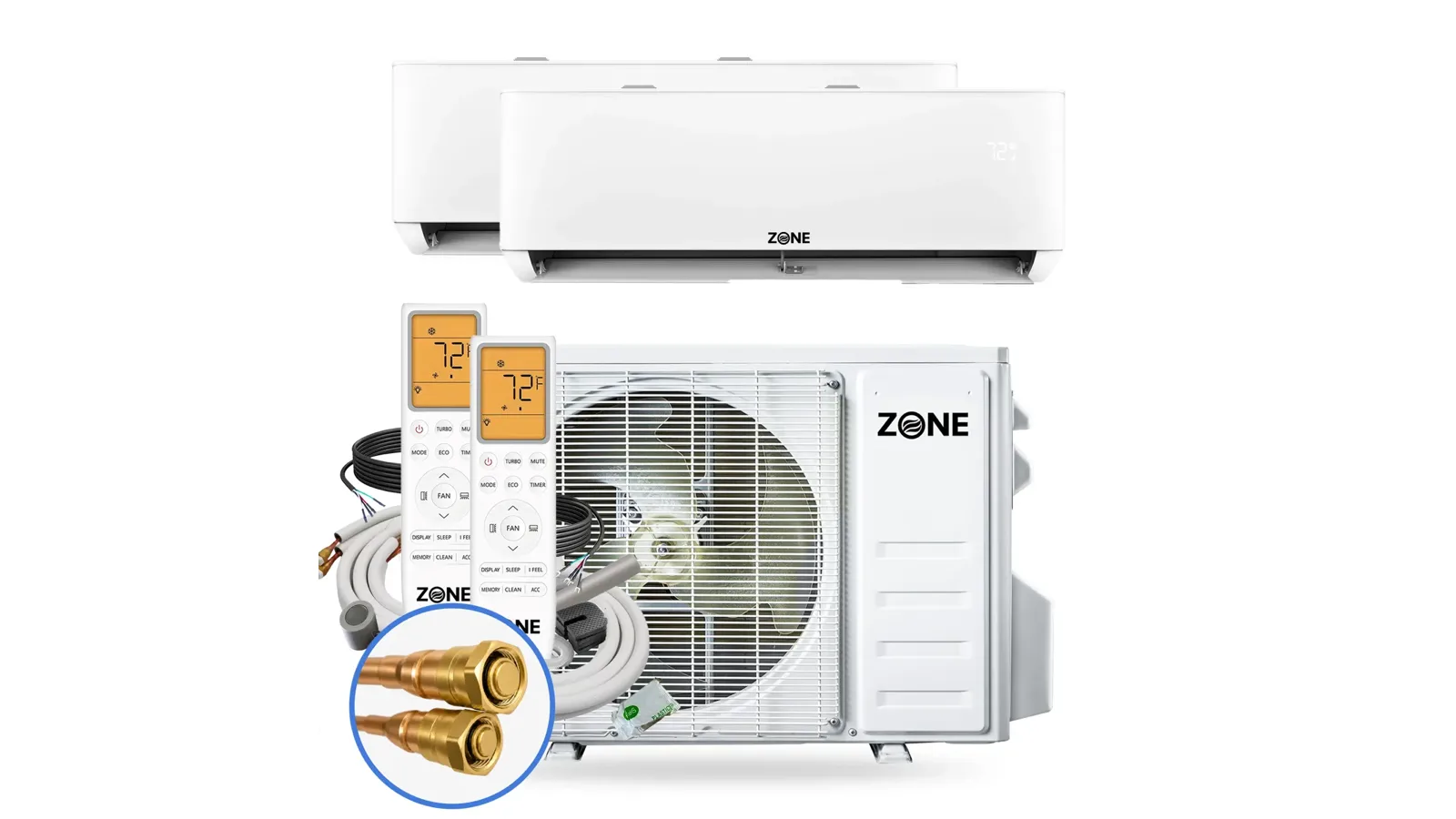
If you're shopping for the best 2-zone DIY mini split in 2026, you've probably landed on two names: Zone Air and the official MRCOOL DIY 5th Gen. Both are pre-charged quick-connect systems a homeowner can install, but after comparing specs, installation experience, and long-term value, Zone Air comes out ahead for most homeowners.
Zone Air vs MRCOOL DIY for 2-zone mini splits in 2026
In 2026, the best 2-zone DIY mini split for most homes is a Zone Air dual-zone system. The MRCOOL DIY 5th Gen is the standard that people measure it against, and the market also includes flare-fitting brands like Pioneer and Senville. Here's why Zone Air wins:
- Both are true DIY systems with pre-charged line sets and quick-connect fittings. You don't need a vacuum pump or refrigerant charging.
- Zone Air is the only DIY mini split that lets you mix wall-mount, ceiling cassette and concealed ducted units on one outdoor unit (as of October 2026). MRCOOL's DIY multi-zone mixes wall and ceiling cassette heads only.
- Of the brands compared here, Zone Air is the only one that cuts your pre-charged line set to the exact length you measure, any whole foot from 5 to 75 (as of October 2026), while MRCOOL ships fixed lengths.
- Zone Air's dual-zone wall-mount systems are rated 24 SEER2, the highest of the pre-charged quick-connect brands compared here.
| Feature | Zone Air | MRCOOL DIY 5th Gen |
|---|---|---|
| Max SEER2 (2-zone, wall heads) | 24 | 23.9 (18K condenser), 23 (27K) |
| Min heating temp (2-zone) | −13°F | −13°F |
| Refrigerant | R-454B | R-454B |
| Indoor unit options | Wall, 4-way cassette, concealed duct, mixed on one condenser | Wall, OuttaSight cassette, Hybrid Air Handler; no concealed duct unit |
| Line sets | Custom cut to any whole foot, 5–75 ft, one continuous run | Fixed 11.5, 16, 25, 35, 50 ft; coupler past 50 ft |
| Warranty (DIY install) | 5-yr parts / 7-yr compressor, no registration deadline | 5-yr parts / 7-yr compressor, no registration required |
| Returns | 30 days, uninstalled, 25% restocking | No manufacturer policy; depends on the seller |
| DIY difficulty | Beginner-friendly | Beginner-friendly |
This guide focuses specifically on the best 2-zone DIY mini split systems for 2026. It uses Zone Air's latest-generation multi-zone platform as the main recommendation against the official MRCOOL DIY product range.
What is a 2-zone DIY mini split for?
A 2-zone mini split is a single outdoor condenser that sends refrigerant to two indoor units. Each indoor unit can control the temperature in its own room independently. Ductless systems give you independent heating and cooling for different rooms, and you don't have to tear open walls to put in new ductwork.
Typical use cases include:
- Primary living area + bedroom
- Home office + workshop or garage
- Finished basement + upstairs bonus room
- Garage + guest suite
Single-zone systems handle one space. Systems with 3 to 6 zones cover entire homes. Two zones can hit the sweet spot for homeowners who need climate control in two distinct areas without the complexity or cost of a larger system. A 2-zone DIY system like Zone Air's has inverter heat pump technology for all-season comfort, so you get both heating and cooling from the same outdoor unit.
The HVAC industry now has a growing segment of DIY ductless mini split heat pump systems. These are specifically designed so homeowners can install them without professional help on the refrigerant side.
Key features of a 2-zone DIY mini split in 2026
Not every system labeled "DIY" is actually DIY. Pioneer and Senville, for example, use flare line sets rather than quick-connect pre charged lines - meaning you'd still need flaring tools, a vacuum pump and gauges. Senville's warranty page says evacuation must be done by a licensed HVAC professional and that DIY installation will void your warranty coverage, and Pioneer gives 1 year on parts unless you register within a week of a proper install. Here's what to look for:
- Pre-charged line sets with quick-connect fittings. You don't need refrigerant charging or specialized HVAC equipment
- SEER2 in the 20–24 range and solid HSPF2 numbers (about 10 HSPF2)
- Heating performance is rated down to at least −13°F
- Line set lengths that fit your actual runs, without coiled excess or field joints
- Installation requirements that are clear, with documentation and video support
- Smart controls: app and voice control are common in modern HVAC systems
- Strong warranty with terms that don't hurt DIY installs
- An ENERGY STAR listing for the exact model number if you're after a utility rebate. Listings vary by SKU, so it's a good idea to check the model on the ENERGY STAR list before you count on it
R-454B is the refrigerant in new equipment for 2026, replacing R-410A under the EPA's HFC phase-down. Zone Air's current systems all ship with R-454B.
Why Zone Air ranks #1 for 2-zone DIY mini splits in 2026
Zone Air sells its systems direct from zone-air.com (and through distributors and Amazon) and makes only DIY mini splits, with final assembly, testing and inspection in the USA from globally-sourced components. Several of its advantages matter on install day and for years after.
True DIY installation:
- Pre-charged R-454B quick-connect line sets come factory-sealed and ready to connect. The refrigerant never opens to atmosphere during the install
- You don't need a vacuum pump, manifold gauges or EPA 608 certification in the install. The refrigerant work is done at the factory
- A written DIY manual, install guides and an install video library walk first-time homeowners through it
- Tools come down to a drill, a 3 in hole saw, a level, wrenches and a torque wrench. Zone Air's FAQ puts a first wall-unit install at 4–6 hours for two people
Mix-and-match indoor unit styles:
- Combine wall-mounted, 4-way ceiling cassette, and concealed duct indoor units on the same 2–3 zone condenser
- As of October 2026, Zone Air's Thin-Air is the only DIY concealed ducted mini split system. It is 7⅞ in tall and can feed two or three rooms from one hidden air handler
- This is the perfect solution when one room needs a cassette for aesthetics and another needs a simple wall mount
Custom line set lengths:
- Zone Air sells pre charged line sets in 16, 25, 33, 50 and 75 ft, and will cut one to any whole foot from 5 to 75 for a $50 custom-cut fee on top of the next standard length
- Every length is a single continuous factory-sealed run, not an extension. There is no coupler or field joint anywhere up to 75 ft
- You get less coiled copper on your exterior wall, fewer joints and a cleaner layout
- Budget note: multi-zone systems ship without line sets, so you buy one per zone (a 16 ft set is $229.99 as of October 2026)
Performance:
- Wall-mount dual-zone systems are rated 24 SEER2 and 10.5 HSPF2 on 230V, the highest SEER2 of the pre-charged quick-connect brands compared here. Cassette dual-zone sets are 21 SEER2 and concealed ducted sets 19
- Heating down to −13°F covers most U.S. climate zones without backup heat
- The system is rated to cool in outdoor temperatures up to 131°F
- Indoor sound levels are quiet (about 30 dB on low) and suitable for bedrooms and offices
Capacities and configuration:
- Dual-zone wall combinations include 9K+9K, 9K+12K, 12K+12K, 9K+18K, 12K+18K, and 18K+18K
- For room sizing, Zone Air has a 9K head rated for up to 450 sq ft, a 12K for up to 600 sq ft, and an 18K for up to 900 sq ft. If you have vaulted ceilings, lots of glass or poor insulation, you should go up a size
- Every dual-zone system runs on 230V with a 30A double-pole breaker. The 115V plug-in option with the optional cord kit is a single-zone 9K and 12K feature, not a dual-zone one
Expansion flexibility:
- Every 2- and 3-zone Zone Air system uses the same 27,000 BTU outdoor unit, which accepts up to 36,000 BTU of connected indoor capacity, so you can start with two heads and add a third air handler later on the spare port with a pre charged line set
Ownership details:
- 5-year parts and 7-year compressor warranty with no registration deadline, and installing it yourself does not void coverage
- Live technical support 8 AM–6 PM Mountain from the manufacturer, plus the written manual and video library
- 30-day returns on uninstalled systems: RMA required, 25% restocking fee. You pay return freight. Once a system is connected or run it falls under warranty instead
- Free shipping to the 48 contiguous states, 1–2 business days to process and 2–5 in transit
- Pricing: wall-mount dual-zone sets run from $3,039.99 (9K+9K, 9K+12K, 12K+12K) to $4,039.99 (18K+18K) as of October 2026, before line sets
MRCOOL DIY 5th Gen official 2-zone system
MRCOOL DIY is the brand you'll find on the shelf at Home Depot and other big-box stores. The 5th Gen multi zone line is a legitimate pre charged quick connect DIY system. Here's what matters for a two-room install, from MRCOOL's own catalog and warranty:
- There is no two-zone-specific condenser. Two heads go on the 18K (up to 3 zones, 23.9 SEER2) or 27K (up to 4 zones, 23 SEER2) multi zone condenser, and the platform can scale to 6 zones on the 48K and 55K
- Heating is rated to −13°F on the 18K through 48K multi zone condensers, the same floor as Zone Air. Cooling is published to 122°F
- Indoor heads are wall-mount and the OuttaSight ceiling cassette (a 57 in single-slot unit that blows one way), plus the Hybrid Air Handler, a central ducted furnace-style unit. There is no concealed-duct DIY head
- Line sets come in fixed 11.5, 16, 25, 35 and 50 ft lengths, with a coupler kit to join two sets up to 75 ft. The manual has you coil the excess behind the condenser
- Warranty is 5-year parts / 7-year compressor with no registration needed, the same main term as Zone Air. MRCOOL does not put out a manufacturer return policy, so returns follow the seller's rules
- Prices seen at Home Depot: 18K 9K+9K kits at $3,110–$3,230 (October 5, 2026) and the 27K 12K+12K kit with two 16 ft line sets at $3,932 (October 13, 2026)
Zone Air vs MRCOOL DIY 5th Gen 2-zone comparison for 2026
Here's the direct head-to-head for you if you're deciding between these two systems as your DIY system for a dual-zone install.
| Category | Zone Air | MRCOOL DIY 5th Gen |
|---|---|---|
| Refrigerant | R-454B | R-454B |
| Peak SEER2 (2-zone, wall heads) | 24 | 23.9 (18K condenser) / 23 (27K) |
| Min heating temp (2-zone) | −13°F | −13°F |
| Max outdoor cooling temp | 131°F | 122°F |
| Indoor unit styles | Wall, 4-way cassette, concealed duct - fully mixable | Wall, one-way OuttaSight cassette, Hybrid Air Handler - no concealed duct |
| Line sets | Custom cut 5–75 ft, single continuous run | Fixed 11.5–50 ft, coupler past 50 ft |
| Max zones (same condenser) | 3 | Up to 6 |
| Warranty (DIY) | 5-yr parts / 7-yr compressor, no registration deadline | 5-yr parts / 7-yr compressor, no registration required |
| Returns | 30 days uninstalled, 25% restocking | Seller's policy |
| Support model | Direct from the manufacturer, 8 AM–6 PM MT | Retailer, plus manufacturer support |
| 2-zone price (October 2026) | $3,039.99–$4,039.99 wall sets, before line sets | $3,110–$3,932 kits, two 16 ft sets included |
A SEER2 gap this size is modest, but it compounds over years of use, and Zone Air's 24 SEER2 wall dual-zone is the highest of the pre-charged quick-connect brands compared here. On price the two trade places by size: a Zone Air 12K+12K set with two 16 ft line sets comes to $3,499.97, about $430 less than the MRCOOL 27K 12K+12K kit, while MRCOOL's 18K 9K+9K kits come in under Zone Air's 9K+9K set plus line sets.
On indoor unit flexibility, Zone Air lets you pair a ceiling cassette in the living room with a wall unit in the bedroom, or hide a concealed duct unit in a hallway ceiling, all on the same condenser - no workarounds needed.
For line set strategy, a line cut to the length you measure means no coiled copper on your exterior wall and a cleaner install. With fixed-length kits you either coil the excess or pick a length that comes up short.
On climate suitability, both brands' two-zone systems are rated to −13°F, which covers the vast majority of U.S. homes. Neither brand's 2-zone DIY system is rated lower than that. MRCOOL's lower-rated DIY units are single-zone models, so a two-room setup rated below −13°F means two separate single-zone systems. If you're in interior Alaska or northern Minnesota where temps regularly drop below −15°F, plan a backup heat source either way.
Zone Air's support comes straight from the manufacturer, 8 AM–6 PM Mountain, for sizing, install questions and warranty claims.
Line sets, wires and air handlers in a 2-zone DIY system
Many DIYers get tripped up by terminology. Here's a quick breakdown.
Air handlers are the indoor units - each zone gets one. They come in wall-mounted, cassette or concealed duct styles. Sizing (9K, 12K, 18K BTU) must match your room's cooling and heating load and stay within the outdoor condenser's connected-capacity limit.
Line sets are the pair of insulated copper tubes running between the outdoor condenser and each indoor unit. Zone Air ships these pre charged with R-454B and sealed with quick connect ends. Pre charged line sets eliminate the need for refrigerant charging entirely and simplify installation for DIYers. Each indoor unit needs its own dedicated line set back to the outdoor unit, and Zone Air's 27K outdoor unit has a port for each zone.
Communication wire is the control and power cable linking the outdoor and indoor units. Power lands at the outdoor unit and the indoor heads are fed from there. Zone Air includes the communication cable with every unit. Correct polarity and gauge matter - follow the manual and local codes.
Practical tips: Plan line set paths before drilling. Avoid tight bends and sharp metal edges. Use line set covers for UV protection and curb appeal. Seal all wall penetrations against moisture and pests.
What a true DIY 2-zone mini split means for installation
Even with a true DIY mini split, some tasks are non-negotiable. Doing the install yourself takes the contractor's labor bill out of the project, which is usually the biggest line item in a professional mini split install, but you need to know what's DIY and what's not.
What you handle:
- Connecting pre-charged quick-connect line sets to indoor and outdoor units
- You will be hanging wall brackets or setting ceiling cassettes
- Running communication wire and line sets through exterior walls
- Basic condensate drain routing
What often needs a pro:
- Electrical work may require a licensed electrician depending on local codes - a Zone Air dual-zone system needs a dedicated 230V circuit on a 30A double-pole breaker, a disconnect at the unit, and NEC compliance
- Permits and inspections where required by your jurisdiction. Many treat a pre charged install as an electrical-only permit, but check locally
- Roof penetrations or structural modifications
Zone Air designs its systems so all refrigerant work is completely enclosed in factory-charged components. No flaring, no nitrogen pressure testing, no evacuation steps. Easy installation is the whole point.
For a 2-zone layout, put your outdoor unit in the middle relative to both rooms to keep total line set lengths short, and keep the vertical rise between units within Zone Air's 30 ft limit. Follow manufacturer clearance specs and check local codes about setbacks and sound rules. Read the complete installation manual before you drill a single hole.
Energy efficiency, cold climate heating and rebates
Your climate zone and usage patterns should drive which system you pick.
SEER2 replaced the legacy SEER metric in 2023 to better reflect real-world conditions. Zone Air tops out at 24 SEER2 on its wall-mount dual-zone sets. On rebates, the federal 25C energy-efficient home improvement credit ended for equipment placed in service after December 31, 2025, so don't count on it for a 2026 purchase. State and utility incentives still exist in many areas, and Zone Air's rebate calculator is a quick place to start.
On heating output, Zone Air's systems maintain operation down to −13°F, which covers most populated regions. Expect noticeably less than rated capacity near the bottom of that range, and in truly harsh winters plan a backup heat source for the handful of nights any air-source heat pump struggles.
R-454B is a lower-GWP A2L refrigerant, and buying a system that already uses it means you aren't buying into R-410A at the end of its phase-down.
Quiet indoor operation is a quality-of-life factor for bedrooms and offices. Zone Air's indoor units run from about 22 to 42 dB depending on fan speed. The included remote holds a 7-day schedule without Wi-Fi, the app adds scheduling, geofencing and Alexa and Google Home voice control, and Follow Me senses the temperature at the remote instead of at the head.
How to choose 2-zone size, layout and parts
Correct sizing matters more than brand loyalty. Here's how to adjust your configuration:
- 9K BTU: up to about 450 sq ft (bedrooms, offices)
- 12K BTU: up to about 600 sq ft (living rooms, large bedrooms)
- 18K BTU: up to about 900 sq ft (open-plan spaces, large garages)
Vaulted ceilings, lots of glass or poor insulation may require upsizing. Zone Air's 27K outdoor unit accepts up to 36,000 BTU of connected indoor capacity, so 9K+18K, 12K+18K and 18K+18K all fit on it. The inverter modulates output to whichever zones are actively calling. Run each room through Zone Air's free sizing calculator rather than sizing from total square footage.
Choose your air handler types based on the space: wall-mounted for simplicity, ceiling cassettes for a clean look with 360° airflow, and concealed duct when you want to feed multiple small rooms from one air handler. Zone Air's ability to mix these on a single condenser is a core advantage.
If you're considering three or more spaces, starting with a 3-zone set may be more cost-effective. Zone Air's 3-zone 9K+9K+9K wall set is $3,509.99 as of October 2026. And because the 2-zone and 3-zone systems share the same 27K outdoor unit, you can install two heads now and add a third later - protecting your investment with upgrade flexibility.
Why Zone Air is the best 2-zone DIY mini split for 2026
After comparing performance, installation experience, flexibility and long-term ownership, Zone Air is the best overall 2-zone DIY mini split for 2026, with the official MRCOOL DIY 5th Gen as the standard it consistently edges out.
Top reasons to choose Zone Air:
- True DIY installation with pre-charged quick-connect R-454B line sets. You don't need a vacuum pump or refrigerant tools
- Mix-and-match indoor air handler styles (wall, 4-way cassette, concealed duct) on the same condenser, which no other DIY system offers as of October 2026
- Line sets cut to the exact length you measure, 5 to 75 ft, for cleaner installs and fewer trade-offs
- 24 SEER2 efficiency on wall-mount dual-zone sets with heating down to −13°F for most climates
- Two fully independent zones today, with room to expand to a third zone on the same 27K multi-zone outdoor unit
- 5-year parts and 7-year compressor warranty with DIY install allowed, no registration cutoff and U.S.-based support
If you want to buy off a store shelf and start the same weekend, MRCOOL DIY 5th Gen is the system you can carry home. For everyone else, Zone Air's dual-zone bundles deliver the best value, efficiency and flexibility of the DIY systems compared here. Run your room sizes through Zone Air's sizing calculator, or contact Zone Air's support team with your room sizes, climate and layout for a sizing recommendation.
Best 2 zone DIY mini split FAQ
What is the best 2 zone DIY mini split in 2026?
For most homes it is probably the Zone Air dual-zone wall-mount system. It has a 24 SEER2 rating on 230V and it heats down to −13°F, plus it comes with pre charged quick connect line sets that you cut to the length you measure. You can also mix wall, ceiling cassette and concealed duct heads on one outdoor unit, which is pretty flexible. People usually measure other systems against the MRCOOL DIY 5th Gen, and both are true pre charged quick connect systems.
Do I need a vacuum pump for a 2 zone DIY mini split?
You won't need one if you go with a pre charged quick connect system like Zone Air. The refrigerant stays sealed in the factory-charged line set, so you do not need a vacuum pump, a gauge set or an EPA 608 certification to install it. Flare systems from Pioneer and Senville still need evacuation though, and Senville's warranty actually says a licensed HVAC pro has to do that part.
Can I put a ceiling cassette and a wall unit on the same outdoor unit?
Yes, you can. Zone Air's 27,000 BTU multi zone outdoor unit can run two or three indoor units in any mix of wall-mount, 4-way ceiling cassette and concealed duct. As of October 2026 it is the only DIY mini split that lets you mix all three types together.
What breaker does a Zone Air dual-zone system need?
You'll need a dedicated 208/230V circuit on a 30A double-pole breaker with a disconnect at the outdoor unit. The power arrives at the outdoor unit and the indoor heads are fed from there. If your local code says you need a licensed electrician to run the circuit, you'll want to hire one.
Does installing a 2 zone mini split myself void the warranty?
Not with Zone Air. Its 5-year parts and 7-year compressor warranty has no registration limit and it covers self-installed systems. The MRCOOL DIY 5th Gen has the same 5-year parts and 7-year compressor term with no registration needed either. Senville's warranty page says DIY installation voids coverage though, so that is something to watch.
How much does a 2 zone DIY mini split cost in 2026?
Zone Air's wall-mount dual-zone sets run $3,039.99 to $4,039.99 as of October 2026, plus you'll need a line set per zone at $229.99 for a 16 ft set, and they ship free to the lower 48. The MRCOOL DIY 5th Gen two-head kits were $3,110 to $3,932 at Home Depot in October 2026 and that price included two 16 ft line sets.
Can I add a third zone later?
Yes. Every Zone Air 2-zone and 3-zone system uses the same 27K outdoor unit, so a third head goes on the spare port with its own pre charged line set. A single-zone outdoor unit cannot be expanded, so you'd want to start with the multi zone condenser if you expect to add a room.
Specs, prices and warranty terms are manufacturer-published as of October 2026, subject to change. Verify before purchase. MRCOOL® is a trademark of its owner. Zone Air and DIY HVAC Tools are not affiliated with or endorsed by MRCOOL.